
Petrochemical
Application of High-Precision X-ray Fluorescence Elemental Analyzer for the Determination of Rare Earth Elements
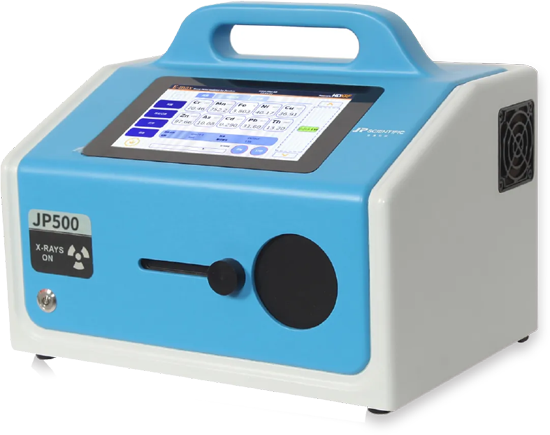
This application note presents a solution for the rapid and accurate analysis of Yttrium (Y), Lanthanum (La), Cerium (Ce), Praseodymium (Pr), Neodymium (Nd), Samarium (Sm), Europium (Eu), Gadolinium (Gd), Terbium (Tb), Dysprosium (Dy), Holmium (Ho), Erbium (Er), Thulium (Tm), Ytterbium (Yb), and Lutetium (Lu) in ion-adsorption type rare earths using the JP500 monochromatic X-ray fluorescence elemental analyzer.
Application Overview
Ion‑adsorption type rare earth ores represent a primary global source of heavy rare earths and yttrium. Current geological exploration specifications for such deposits continue to use total rare earth content as one of the evaluation parameters. However, the commercially valuable and recoverable fraction in ion‑adsorption type ores is the “ion‑phase” rare earth elements. Accordingly, the evaluation focus should be directed toward ion‑phase rare earth elements. The determination of individual ion‑phase rare earth elements provides a more direct reflection of the rare earth distribution and major composition, offers improved insight into the economic value of a given deposit, and supports a more refined and reasonable assessment of rare earth resource reserves.
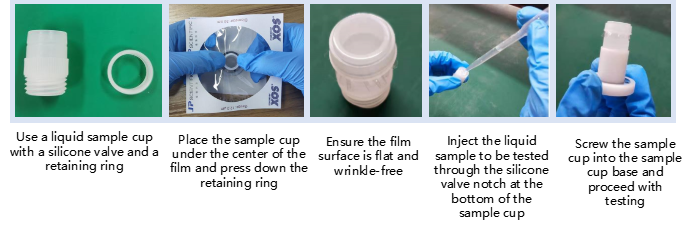
Field exploration for ion‑adsorption type rare earths currently relies largely on the conventional “field titration method.” This approach is subject to notable interference from impurities in the weathering crust, cannot fully indicate ion‑phase rare earth elements, and offers limited guidance for individual ion‑phase species. This application note introduces an alternative field analytical approach: ion‑phase rare earth elements are leached and extracted from weathering crust samples using ammonium sulfate solution, followed by determination of individual ion‑phase rare earth element content via high‑precision X‑ray fluorescence (HPXRF).
Reference: Zhang Lei, Wang Jingjing, et al. Portable X‑ray Fluorescence Spectrometry (XRF) for Field On‑site Determination of Ion‑Adsorption Type Rare Earths[J]. Chinese Journal of Inorganic Analytical Chemistry.
Technical Principles
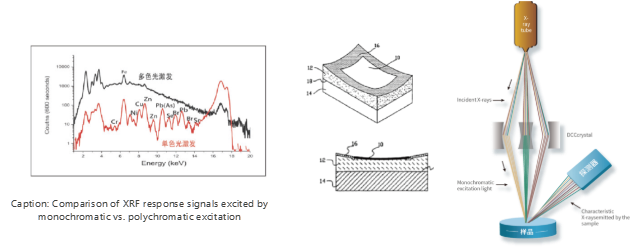
The High-Precision X-ray Fluorescence Elemental Analyzer (HPXRF) utilizes Monochromatic Focusing Doubly Curved Crystal (DCC) optics, which monochromatize polychromatic X-rays from the source and effectively focus them onto the sample. This greatly enhances the instrument's signal-to-noise ratio. Upon monochromatization, elements in the sample emit characteristic X-ray fluorescence signals. These signals are collected and processed by a high-resolution Silicon Drift Detector (SDD), and the software's Fundamental Parameter (FP) algorithm calculates the elemental content in the sample.
Sample Testing
Sample Preparation Method
Performance Data
Working Curves
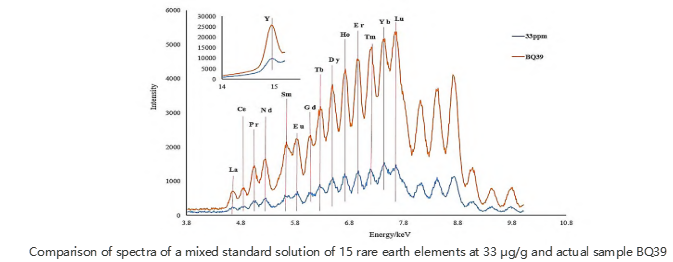
A mixed standard solution was prepared from single rare earth element standard solutions (element concentration of 1000 μg/mL) to establish working curves for 15 rare earth elements in solution, with concentration gradients of 0, 33, 50, and 67 μg/mL. The coefficients of determination (R²) for each element ranged from 0.9997 to 0.9919.

Repeatability
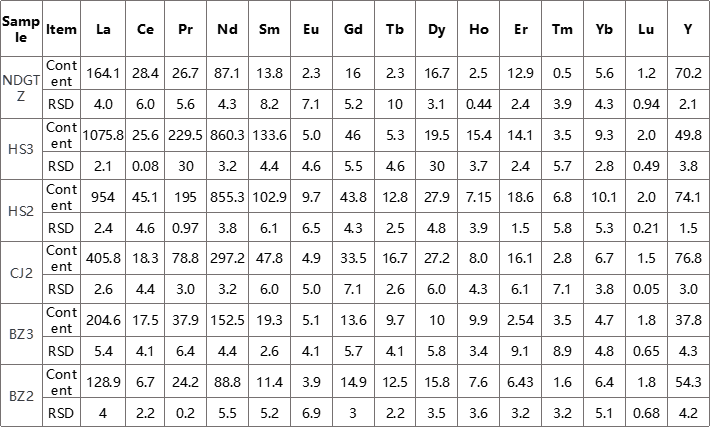
Six actual ion-adsorption type rare earth samples from the Nanling region, representing three lithologies (volcanic rock, metamorphic rock, and sedimentary rock), were selected. They were measured 10 times, and the relative standard deviation (RSD) was calculated. The RSD for all elements was < 10%.
Comparison with ICP-MS Test Results
The content of rare earth element solutions was tested using HPXRF, selecting the rare earth liquid curve for the working curve. ICP-MS determination was simultaneously performed as an indoor comparison test.
Features and Advantages