
Application of High-Precision X-ray Fluorescence Elemental Analyzer for the Determination of Silicon, Aluminum, Iron, Calcium, Magnesium, Sulfur, Potassium, and Titanium in Cement Raw Meal, Clinker, and Limestone
Industrial Elemental Analysis

Application of High-Precision X-ray Fluorescence Elemental Analyzer for the Determination of Silicon, Aluminum, Iron, Calcium, Magnesium, Sulfur, Potassium, and Titanium in Cement Raw Meal, Clinker, and Limestone
This application note presents a solution for the precise quantitative analysis of elements such as Silicon, Aluminum, Iron, Calcium, Magnesium, Sulfur, Potassium, and Titanium in cement raw meal, clinker, and limestone using a high-precision X-ray fluorescence elemental analyzer.
Application Overview
In cement production, the elemental composition of limestone, raw meal, and clinker directly affects raw meal proportioning and clinker calcination quality. Traditional chemical detection methods involve cumbersome pre‑treatment and lengthy analysis cycles, which cannot provide timely feedback to the production line, often resulting in process delays and fluctuations in product quality. This application employs a high‑precision X‑ray fluorescence elemental analyzer, specifically tailored for process control in cement plants. It enables accurate quantitative analysis of multiple elements (Si, Al, Fe, Ca, Mg, S, K, Ti) in cement raw meal, clinker, and limestone. Without complex pre‑treatment, the analyzer promptly delivers detection data, offering timely evidence for raw material blending and pre‑kiln adjustments, thereby supporting stable cement production and compliance with industry quality control standards. The equipment is designed to meet the requirements of the method standard JC/T 1085‑2008 "X‑ray Fluorescence Analyzer for Cement".
Technical Principles
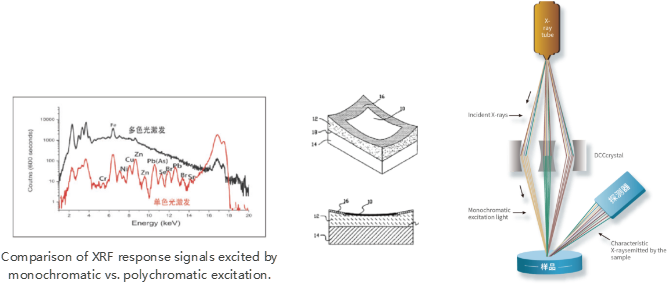
The High-Precision X-ray Fluorescence Elemental Analyzer (HPXRF) utilizes Monochromatic Focusing Doubly Curved Crystal (DCC) optics, which monochromatize polychromatic X-rays from the source and effectively focus them onto the sample. This greatly enhances the instrument's signal-to-noise ratio. Upon monochromatization, elements in the sample emit characteristic X-ray fluorescence signals. These signals are collected and processed by a high-resolution Silicon Drift Detector (SDD), and the software's Fundamental Parameter (FP) algorithm calculates the elemental content in the sample.
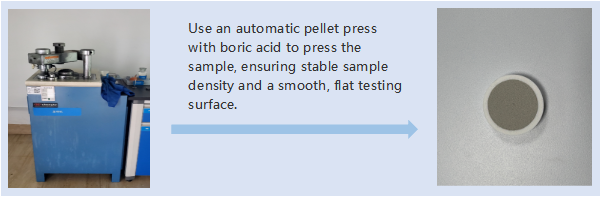
Sample Preparation Method
Performance Data
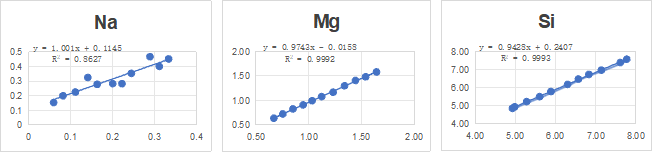
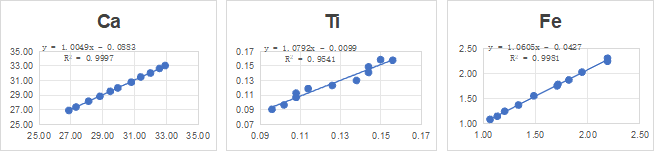
Standard Curve
Standard samples from the GSB 08-1110-2013-R1 ~ R11 national cement raw meal series were used to establish the standard curves, calibrated with the element standard values provided by the certificates.
Parallelism
The following shows the parallelism data of the primary focused elements and other elements in the sample.


Repeatability

Features and Advantages